


If You Love the Devon Rex, Don't Support Minskin Breeding

The Devon Rex is an established pedigree breed with a distinctive appearance, extraordinary temperament and a genetic heritage that responsible breeders have spent decades trying to preserve.

It should not be used as an ingredient in designer dwarf-cat breeding.
Yet Devon Rex cats have been incorporated into breeding programs for the Minskin - a designer cat(not even a recognized breed in any association (more on the TICA decision to shut down the progress of an experimental breed, below) developed by combining multiple breeds and multiple mutations to produce cats with very short legs and altered coats.
For people unfamiliar with feline genetics, the resulting kittens can simply look unusual or cute.
But there is a much bigger issue behind that appearance.... The characteristic short legs originate from disproportionate dwarfism. This is not simply a naturally small cat. Scientific research has identified a structural genetic variant associated with abnormal skeletal development.
And major cat organizations have increasingly taken explicit positions against deliberately creating breeds by combining these kinds of structural mutations.
For Devon Rex breeders and owners, there is therefore a simple question worth asking:
If we love the Devon Rex, why would we deliberately use it to produce cats whose defining characteristics include a skeletal abnormality?
First: Munchkin-Type Short Legs Are Dwarfism
The short legs associated with the Munchkin (a real breed by itself in SOME associations with that singular and inherited mutation) by Munchkin-mixed designer cats, are sometimes described casually as though they were simply another body type.
Scientifically, that is inaccurate.
A peer-reviewed 2020 study published in BMC Genetics investigated the genetics responsible for the Munchkin phenotype.
Researchers identified a structural variant involving the UGDH gene that was perfectly associated with the short-legged phenotype in the cats studied.
Their conclusion was straightforward:
“This UGDH structural variant very likely causes the chondrodysplastic (standard) phenotype in Munchkin cats.”
In other words, this is chondrodysplasia: disproportionate dwarfism involving skeletal development.
Even more concerning, researchers found no cats carrying two copies of the mutation. Combined with reduced litter sizes, the researchers concluded that the evidence suggested that inheriting two copies may be lethal in the homozygous state.
That means that the surviving short-legged cats therefore appear to inherit the chondrodysplastic condition dominantly, while embryos inheriting the mutation from both parents may not survive.
You can read the research directly through the U.S. National Library of Medicine:
This matters because breeding for short legs isn't comparable to breeding for blue eyes or a particular coat colour.
The altered skeletal development is the phenotype being deliberately selected. Now Munchkins to be clear, if bred with only one short legged parent, can be handled ethically, but due to the nature of many of the population not understanding the damage that can be caused, some associations have simply chosen not to recognize the breed, while others have. This article is NOT about the Munchkin, but rather information for context on why that gene could be problematic in the wrong hands, let alone the combination of multiple other mutations.
Why Combining Mutations Raises an Additional Ethical Concern
The Minskin goes a step further.
Its purpose isn't simply to reproduce dwarfism. The breed was developed by combining characteristics from different breeds to produce multiple unusual physical traits in the same animal.
TICA's own historical records are remarkably revealing on this point.
In a 2019 Minskin breed report submitted to TICA, the breed's founder described the Minskin as a “double-mutation breed” involving both a dominant physical anomaly and a recessive cosmetic anomaly.
That isn't language coming from critics of the breed. It appears in the Minskin's own historical breed report submitted to TICA.
There is an important scientific distinction here.
It would be inaccurate to claim that combining any two mutations automatically causes disease. Genetics doesn't work that way.
The concern is instead about deliberately stacking unusual physical mutations when the welfare consequences of their interaction have not been adequately established.
It's not just theoretical either, it became significant enough that TICA changed its rules!
TICA Specifically Acted Against the Creation of New Structural-Mutation Designer Breeds
TICA, the ONLY one of CFA, TICA, ACFA and CCA that even recognizes the parent breed, Munchkin. Took this step as a result of careful consideration and reviews about ethics from other associations across the world as well. This part of the history is especially important because Minskin breeders sometimes advertise TICA registration as evidence that the breeding concept has been endorsed by TICA.
That leaves out a very important part of the story.
TICA once allowed these designer breeds into its development system.
Historical TICA documents confirm that Minskin, Dwelf and Skookum were among breeds considered for Registration Only status as far back as 2006.
But the cat fancy's understanding and policies surrounding structural-mutation designer breeds subsequently changed.
And TICA's own records explain why.
In 2014, TICA Confronted the Problem Directly
A proposal presented to TICA in 2014 was literally titled:
“Stop combining of Structural Mutations.”
Its stated purpose was:
“to stop the creation of new breeds based on combining structural mutations simply because it's possible.”
The proposal specifically identified designer breeds combining mutations—(including crosses involving Munchkins) and expressed concern that too little was known about the potential effects of combining structural mutations.
It also identified another problem that remains relevant today: breeders were using Experimental TICA status to advertise cats as though they were fully “recognized” by TICA.
The proposal's rationale specifically warned about this practice.
And this wasn't simply someone's opinion buried in an agenda.
TICA's Board subsequently carried the motion to amend its Registration Rules.
The resulting rule is extremely important.
TICA defines a structural mutation as an alteration in skeletal and/or cartilage expression compared with the average domestic cat, specifically giving shortened legs as an example.
And TICA Registration Rule 33.2.1 states:
“Breeds that have a structural mutation as a breed characteristic must not be used as source breeds.”
Think about what that means.
Shortened legs are explicitly identified by TICA as a structural mutation.
And TICA's modern rules prohibit breeds characterized by structural mutations from being used as source breeds in creating new domestic hybrid breeds.
Then TICA Went Back and Dealt With the Old Experimental Breeds
There was still a historical problem.
Several designer breeds involving structural mutations had entered TICA's Experimental Record before these restrictions existed.
They were effectively grandfathered remnants of an earlier system.
TICA eventually addressed those too.
At its 2025 Annual Meeting, the TICA Board considered Experimental breeds that did not comply with its newer Registration Rule 33.1.2.3.
The Board voted unanimously to terminate their Experimental status, effective immediately.
Among the breeds removed were:
Bambino, Dwelf, Elf, Genetta, Kinkalow, Lambkin, Scottish Kilt, Skookum and numerous other experimental designer breeds.
This is not interpretation or gossip.
It is recorded directly in TICA's official 2025 Annual Meeting minutes:
TICA once permitted numerous experimental designer breeds involving combinations of unusual mutations to enter its development system.
It subsequently changed its rules to prevent structural-mutation breeds from being used to create new hybrid breeds, and it ultimately terminated the Experimental status of numerous older programs that did not comply with the newer requirements.
But Isn't the Minskin Still Registered With TICA?
Yes—and this distinction needs to be understood correctly.
Minskin achieved Registration Only status historically and consequently occupies a different administrative position from the experimental breeds TICA terminated in 2025.
TICA's Registration Rules have listed the Minskin among Category IV Domestic Hybrid Breeds.
That does not mean Minskins have TICA Championship recognition.
They do not. And will not.
And it certainly does not erase TICA's subsequent rule prohibiting breeds characterized by structural mutations from being used as source breeds when creating new domestic hybrid breeds.
That makes claims such as “TICA recognized” potentially very misleading when presented to the public without explanation.
Registration Only status is not Championship recognition. IE; Recognized as a full fledged legitimate breed, alongside all the others that earned their way to that status.
FIFe Goes Much Further: No Breeding, Registration, Showing or Promotion
TICA isn't the only major international organization concerned about dwarf breeding.
The Fédération Internationale Féline (FIFe) takes an even stronger position.
Its current Health & Welfare Rules specifically address cats suffering from what it describes as (pseudo-)achondroplasia, resulting in dwarfism and shortened limbs, and gives the Munchkin as its example.
FIFe says cats affected by it or with such a cat in their ancestry:
cannot be used for breeding;
cannot be registered with FIFe;
cannot be exhibited at a FIFe show;
and
cannot be promoted or advertised.
Its show rules additionally state plainly:
Dwarf cats are not admitted to FIFe shows.
This is about as unequivocal as a major international cat organization can possibly be.
GCCF: “There Is No Intention to Recognise Munchkins or Any Other Dwarf Breed”
The Governing Council of the Cat Fancy (GCCF) has taken a similarly direct position.
GCCF states:
“There is no intention to recognise Munchkins or any other dwarf breed.”
Its welfare policy explains that GCCF decided decades ago that it would not recognize new breeds based upon abnormal structure or development.
Its breeding policy goes further when discussing deliberately combining abnormalities.
GCCF says structural anomalies provide “no positive welfare benefits for the cat” and warns that:
“Doubling or trebling such anomalies for the appeal of novelty or oddity is likely to increase greatly the risk of a deleterious impact.”
The policy specifically identifies shortened limbs, such as the Munchkin, among the characteristics on which GCCF will not recognize a new breed.
GCCF's current information for prospective cat owners likewise categorizes “Munchkin, Minuet (and other dwarf breeds)” as ineligible for GCCF recognition because of reported health problems.
So this is not simply one breeder's philosophical objection to Minskins.
Multiple major organizations within the international cat fancy have explicitly objected to breeding cats around structural abnormalities, dwarfism and/or combinations of mutations.
What Does Any of This Have to Do With the Devon Rex?
Everything! ....if Devons are being supplied to these breeding programs.
Responsible outcrossing exists in the Devon Rex.
But this isn't it.
CFA currently permits the American Shorthair and British Shorthair as Devon Rex outcrosses. CFA states that kittens born on or after CFA currently permits the American Shorthair and British Shorthair as Devon Rex outcrosses.
There is a reason legitimate Devon Rex outcrossing has existed.
The entire modern Devon population ultimately traces back to a very small foundation. CFA's history of the breed explains that outcrossing was undertaken because heavy early inbreeding concentrated genetic problems and breeders needed to broaden the gene pool.
The purpose was therefore to improve and preserve the Devon Rex.
Taking a Devon Rex and breeding it into a dwarf-cat program is fundamentally different.
The objective isn't to improve the Devon Rex gene pool.
The resulting breeding program isn't moving back toward the Devon standard.
It isn't attempting to produce healthier Devons.
It is taking desirable/marketable characteristics associated with the Devon Rex and incorporating them into an entirely different designer animal whose defining characteristics include dwarfism.
Calling both practices “outcrossing” does not make them ethically equivalent. Nor is it true in to the spirit of what outcrossing is supposed to do.
The Devon Rex Already Has a Mutation Worth Protecting Responsibly
The Devon Rex's famous coat is itself the product of a random mutation.
But there is an enormous difference between recognizing a naturally occurring breed characteristic and treating pedigree cats like a catalogue of mutations that can be stacked together to create increasingly unusual animals.
Short legs from one breed.
A coat mutation from another.
Hairlessness from another.
Folded or curled ears from another.
And then another novel appearance is marketed.
At some point responsible breeding has to ask something more important than:
Can we make this?
Much like Jurassic Park, we need to ask:
Should we?
That is precisely the concern reflected in TICA's historic proposal to stop combining structural mutations and in GCCF's warning against “doubling or trebling” anomalies for novelty.
“But My Minskin Runs and Jumps Just Fine”
That doesn't resolve the ethical question.
The claim here should not be that every Minskin is destined to live in pain.
Current scientific evidence does not establish that.
The argument is both simpler and much harder to dismiss.
We know that the characteristic short-legged phenotype is associated with a structural genetic variant causing chondrodysplastic dwarfism.
We know that researchers have documented abnormal growth-plate cartilage in affected dwarf cats.
We know that the available genetic evidence suggests inheriting two copies of the dwarfism-associated mutation may be lethal.
And we know that major feline organizations have considered the deliberate perpetuation and combination of structural abnormalities serious enough to restrict or completely prohibit such breeding.
A cat appearing happy does not answer any of those points.
The ethical question isn't whether an individual Minskin can be loved or have a happy life.
Of course it can.
The question is whether humans should deliberately manufacture more cats with abnormal skeletal development simply because we like the way it looks.
Those are completely different questions.
Why We Believe Devon Rex Breeders Who Participate Should Be Avoided
A responsible preservation breeder is supposed to be a custodian of their breed.
That means making decisions based on what protects the breed for the next generation and definitely not simply what can be produced or sold as unique or rare. Have we learned nothing from Pocket Bullies, Fluffy Frenchies and every variety of Doodle?
A Devon Rex breeder knowingly supplying breeding cats to a Minskin or other dwarf designer-cat program is making a breeding choice that deserves scrutiny.
They are allowing the Devon Rex to be used in a program deliberately selecting for a structural dwarfism mutation.
That does not improve the Devon Rex.
It does not preserve the Devon Rex.
It does not increase healthy genetic diversity within the Devon Rex population.
And it isn't necessary to maintain the breed.
For prospective kitten buyers looking for a preservation breeder, we recommend avoiding entirely, Devon Rex breeders who knowingly produce Minskins or knowingly supply breeding animals to Minskin or other dwarf-cat programs.
There are plenty of breeders working toward healthier, genetically diverse, structurally sound Devon Rex cats without deliberately adding dwarfism to the equation.
Please.... please.... Support them instead. Regardless of any kittens cute factor.
If You Love Devons, Protect Devons
There will always be a market for unusual animals.
Extreme features attract attention. Novelty sells.
But responsible breeding cannot simply mean producing whatever consumers are willing to buy.
The Devon Rex is extraordinary exactly as it is.
There are legitimate challenges facing our breed: maintaining genetic diversity, screening breeding cats appropriately, monitoring cardiac health, understanding pedigrees, preserving correct structure and temperament, and making thoughtful use of legitimate outcross programs where permitted.
Creating dwarf Devons isn't one of them.
The scientific literature identifies the short-legged Munchkin phenotype as chondrodysplasia. CFA,ACFA and CCA flat out don't recognize the parent breed let alone a multi-mutant breed.
FIFe prohibits dwarf cats and cats with dwarf ancestry from breeding, registration and exhibition.
GCCF refuses recognition to dwarf breeds and specifically warns about combining multiple anomalies for novelty.
TICA itself adopted rules preventing breeds characterized by structural mutations from being used as source breeds for new domestic hybrid breeds, and in 2025 unanimously terminated numerous older Experimental designer-breed programs that did not comply with its newer rules.
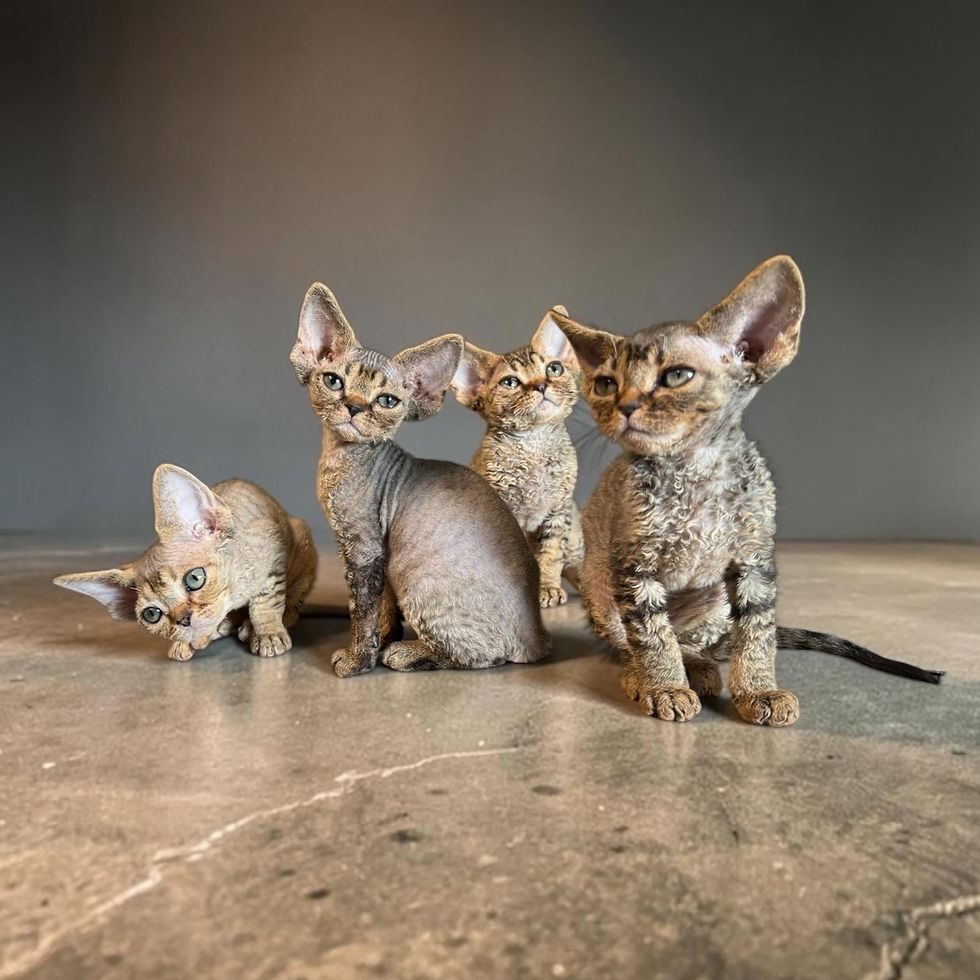
Those facts deserve considerably more weight than an Instagram photograph of a cute kitten.
If you love the Devon Rex, protect the Devon Rex.
Don't turn it into an ingredient for designer dwarf cats.
Sources & Further Reading
Scientific research — Munchkin dwarfism:Struck et al., A structural UGDH variant associated with standard Munchkin cats — PubMed
Scientific research — feline dwarfism and cartilage:Buckley et al., A new domestic cat genome assembly and identification of a gene for dwarfism — PubMed
TICA — structural-mutation rule history:2014 Annual Meeting Agenda — “Stop combining of Structural Mutations” proposal
TICA — adoption of structural-mutation restrictions:2014 Annual Meeting Minutes
TICA — current/historical Registration Rules:TICA Registration Rules
TICA — termination of noncompliant Experimental breeds:2025 Annual Meeting Minutes — Motion 8
FIFe — dwarf-cat restrictions:FIFe Health & Welfare Rules
GCCF — position on dwarf breeds:GCCF Welfare Policy
GCCF — breeding policy and multiple structural anomalies:GCCF Breeding Policy
CFA — Devon Rex allowable outcrosses:CFA Devon Rex Breed Standard
CFA — history and purpose of Devon Rex outcrossing:CFA Devon Rex History


Comments